LotTrailby SmartFACT

LOTTRAIL · FREE TIER

Backward traceability: from a customer complaint to the supplier lot

Updated

Backward traceability starts from a finished unit or a customer complaint and works back through the records to the material lots it was made from. LotTrail starts from the unit’s serial number, follows the relationships your records state back to its recorded inputs, as known at a stated time, and shows where the records stop.

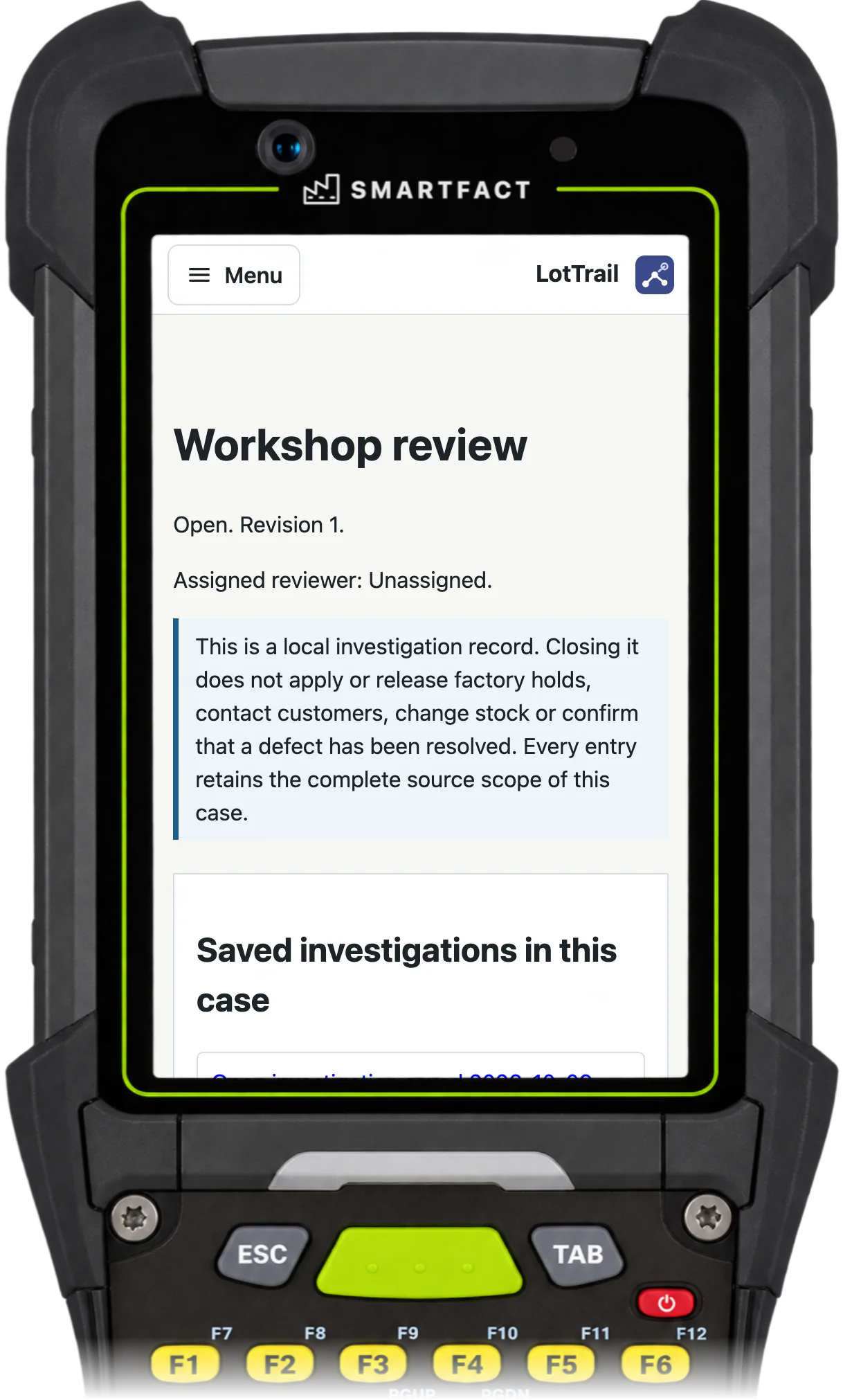
LotTrail investigation case Workshop review, with its notice that closing a case applies no holds, contacts no customers and changes no stock
A case keeps the saved traces behind an answer, and takes no factory action, on a handheld or scan station.
Backward traceability: from a customer complaint to the supplier lot · 3:10 · Watch on YouTube

Where did this unit come from?

Start from the serial number in a customer or warranty question and follow it from output towards input, back through rework and production to the material lots recorded as its inputs. Each step shows its source dataset, and a supervisor’s reviewed identity link carries the trace from your own lot code to the supplier’s.
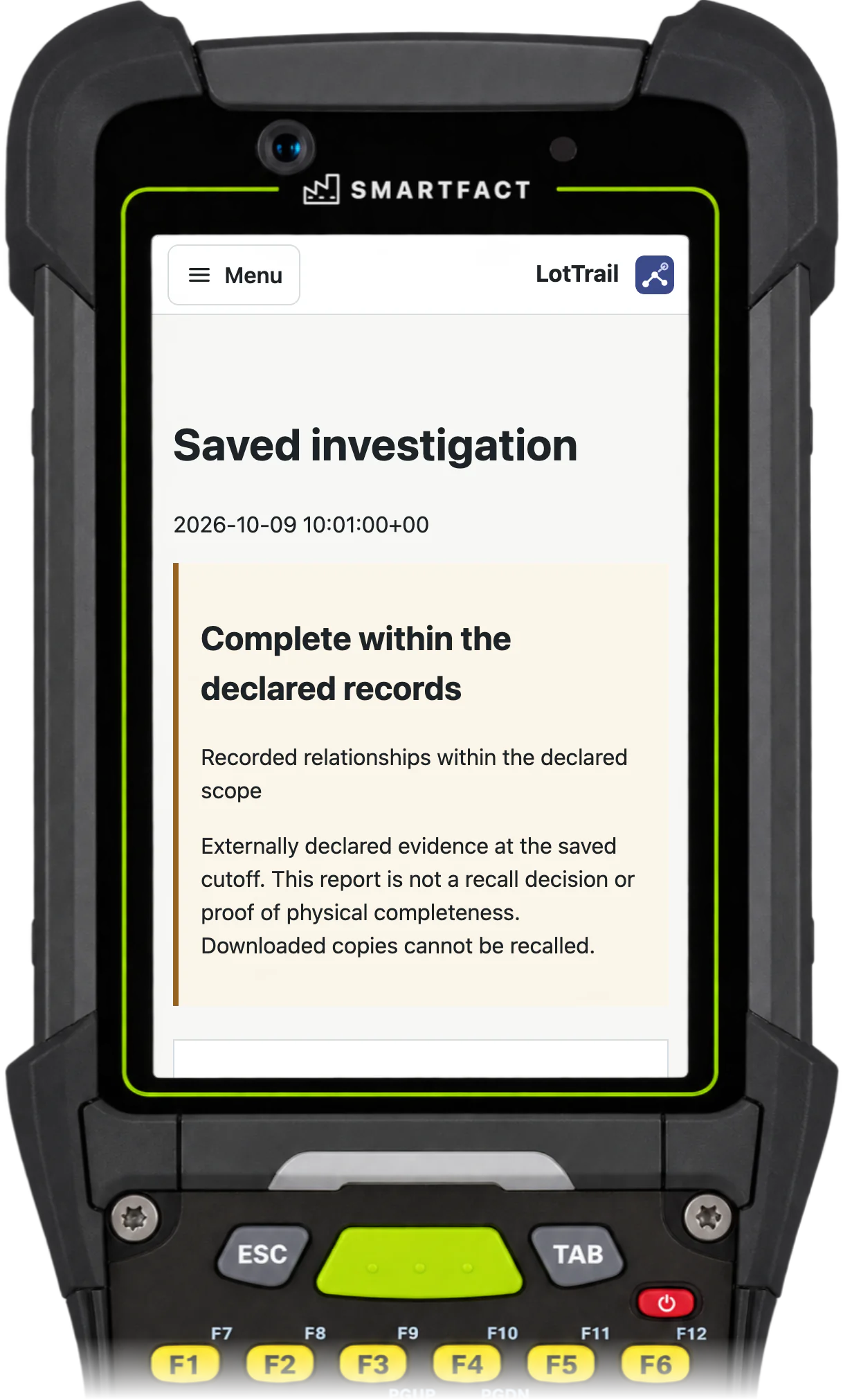
LotTrail saved investigation headed Complete within the declared records, with its coverage notice
Every saved trace opens with what its records cover, on a handheld or scan station.

As known at a point in time

Run the investigation as the records stand now, or as they were known at an earlier cutoff. A saved run keeps that boundary, so you can show what was known when you answered.

Sharing a saved run

Authorised people can download a saved run as JSON, rechecked against current dataset access. It states its scope and coverage. It is an evidence snapshot, not a certified recall record.

A case gathers the saved runs and review notes behind an answer. Opening it still needs access to every dataset it uses.

Where the records stop

If the serial number is not in the selected evidence, LotTrail says so instead of returning an empty answer. Check the source, type, namespace and exact code, then ask for the missing evidence. A missing record never proves that a unit is unaffected.
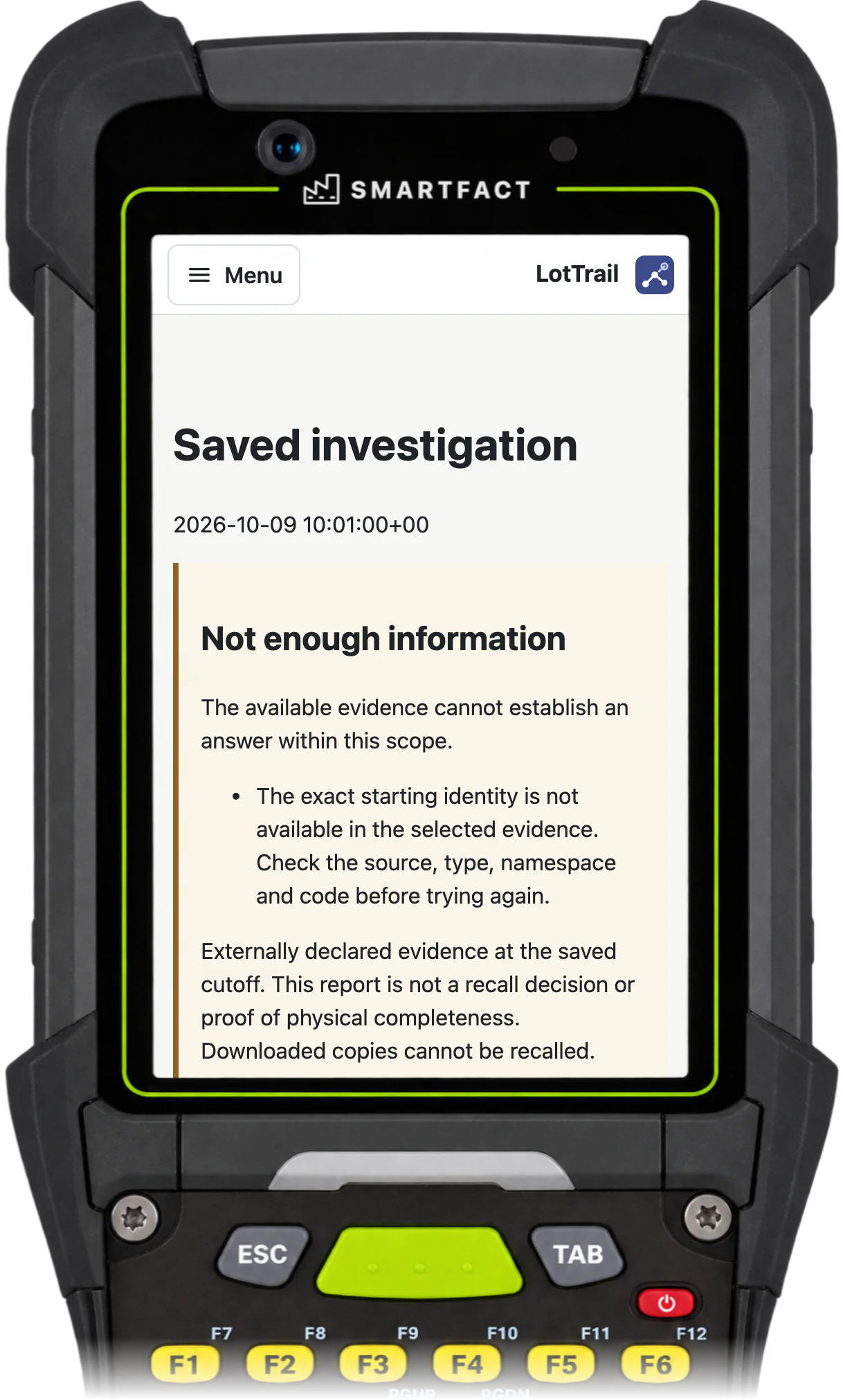
LotTrail saved investigation headed Not enough information, because the exact starting identity is not in the selected evidence
A trace that cannot start says why, on a handheld or scan station.

What LotTrail does not do

  • Customer notices or contact. The answer you send stays in your own process.
  • Recalls, holds or stock changes.
  • Certified recall records. A saved run downloads as JSON, or as a PDF evidence pack of what the records showed at its cutoff.
  • Inferred links. Timing, similar codes, scans, kit checks, label prints and bookings never create a link.

Common questions

Can lot numbers be traced?

Yes, wherever they are recorded. A lot number can be followed through every record that names it and states how it relates to other lots, products or shipments, such as a goods receipt, a production record and a despatch note. Where a record is missing, the trace stops there, and a good trace shows where.

What does lot tracking mean?

Lot tracking means recording a lot or batch number against material as it is received, used and shipped, so each lot can be found again later. Lot traceability uses those records to follow a lot forwards to where it went, or backwards to where it came from.

Start free at one station and pay when you grow. While SmartFACT is in early access, we set your first workflow up with you.

FREE TIER

Which traceability question takes longest to answer?

Tell us what you need to trace and where the records are kept. We arrange a demonstration and set your first two sources up with you, free, while SmartFACT is in early access.

Start free

Free at one station. Set up with you while SmartFACT is in early access.

THE SMARTFACT SUITE

SmartFACT services
and free tools.

Automate factory decisions with rules you describe in plain English. Explore focused SmartFACT services, plus free tools for everyday checks. The free tools need no account.

Free tool

ScannerBench

See the text and key events your keyboard scanner sends. Compare them with the value you expected.

Test a scanner
Free tool

PrintBench

Print a known PDF, measure its reference marks and compare scans from the printed codes.

Check a print
Free tool

CardBench

Create 100 × 50 mm bin and rack cards with Code 128 or QR, from one record or a CSV.

Make bin cards
Free tool

CountBench

Count stock by location with a barcode scanner, compare it with a stock file and export the results.

Start a free count
Free tool

BarcodeBench

See exactly what a scanned barcode contains, with hidden characters shown and GS1 fields, check digits and dates explained.

Inspect a barcode
Free tool

MatchBench

Scan a reference and each label, see an exact match or the first difference, and download the results.

Start a free comparison
Free tool

TagBench

Scan an item or location, note what needs attention, print a review tag and keep a review list.

Make a free tag
Free tool

FindBench

Load your own parts and locations CSV, scan a code and see every location it lists.

Start a free lookup
Free tool

ManifestBench

Check cartons, pallets or serial numbers against a list with a phone or scanner and see what is missing.

Start a free check
Free tool

FeedBench

Check CSV and JSON files exactly as written, preview a column mapping and compare two versions by key.

Check a file free
Free tool

CycleBench

Time work cycles and changeovers on a phone, record interruptions with reasons and download the results.

Start a free study
Free tool

OffcutBench

Label the offcuts on your rack, find a piece long enough before cutting new stock and record what you used.

Track offcuts free
Free tool

TraceBench

Load one or two CSV exports and follow a lot or serial forwards or backwards, with the row behind every link.

Start a free trace
Free tool

ReclaimBench

Record the parts recovered from each return, label them with a QR code, check them and record the unit each one goes into.

Track recovered parts free
Free tier

LabelRules

Describe label rules in plain English. Automatically select layouts, resolve customer codes and check each job before printing.

Explore LabelRules
Free tier

KitProof

Turn plain English component rules into automatic kit checklists, then check scans against the expected parts and quantities.

Explore KitProof
Free tier

WorkSteps

Turn plain English rules into automatic step selection for each unit, with required evidence and a record of completed work.

Explore WorkSteps
Free tier

FactorySpec

Apply approved product rules and calculations automatically to turn dimensions and options into manufacturing requirements.

Explore FactorySpec
Free tier

SmartFACT Data

Maintain reference tables with ConfigSheets or bring shop orders into SmartFACT through reviewed connectors. Check changes and deliver data to the products that use it.

Explore SmartFACT Data
Free tier

OrderRun

Turn plain English rules into automatic order checks and destination selection, with controlled production release.

Explore OrderRun
Early access

ParcelOffice

Scan the work order and the parcel choice to book the courier and print the labels. Approved plain English rules recommend or choose the parcel.

Explore ParcelOffice
Free tier

RefillFlow

Scan an empty container to send the right refill request to stores. Approved plain English rules set the stores queue, priority, ticket printer and escalation.

Explore RefillFlow
Free tier

RemnantRack

Label each offcut, find a suitable length before cutting new stock and record what you used. Approved plain English rules decide what to keep and where it goes.

Explore RemnantRack
Free tier

ToolCustody

Check a shared tool before handover, record who has it and keep damaged or overdue tools out of the next issue. Start free with one crib.

Explore ToolCustody
Free tier

StoresFlow

Receive, put away, reserve and issue stores material with barcode checks, keeping held, reserved and available stock apart. Start free with one stockroom.

Explore StoresFlow
Free tier

LotTrail

Follow a lot or serial number through the records your factory already keeps, with the source of each link and the gaps shown. Start free with two declared sources.

Start free
Early access

CheckStation

Scan an identified unit to get its approved final-inspection checks, then record exact readings with their result, holds and release history.

Explore CheckStation
Free tier

ReclaimStation

Book returned units in, recover and label the usable parts, release them independently and record the unit each goes into. Start free with one product family.

Explore ReclaimStation
Free tool

GuidBench

Generate GUIDs, UUID v4 and v7, ULIDs and Nano IDs, format and download batches, or inspect a UUID in your browser.

Generate identifiers
Free tool

OctetBench

Inspect and edit text, hex, Base64 and binary bytes in your browser, reveal hidden characters and compare byte sequences.

Inspect some bytes
Free tool

PatternBench

Test JavaScript regular expressions in your browser, inspect matches and captures, preview replacements and check expected cases.

Test a pattern
Free tier

SmartFACT Purchasing

Collect purchase requests, approve supplier orders and track what is still to arrive. Start free at one site.

Explore Purchasing
Free tier

SmartFACT Automation

Describe, test, approve and audit the automation rules of every SmartFACT product in one place. Included with each product’s paid plan, or on its own.

Explore Automation
Help

SmartFACT Help

Step-by-step guides and interactive demonstrations for the SmartFACT suite. Read the instructions, watch a task or practise with real product screens and sample data.

Open SmartFACT Help